Friday, March 9, 2012

POETRY SPILL

O Waiting Throngs of Blog Readers, I bring to thee a poetry game. Take a dictionary, close your eyes, flip through the dictionary and, without opening your eyes, pick a word. Write it down. Do this seven times. Then write a poem using at least five of the words you randomly picked. Here are the words I picked:

eventful
record
unheard
man
unravel
centurion
schismatic

Here is the poem:

Eventful lentil
sacramental,
you record,
so small,
unheard,
rain scribing on a leaf
so small,
this day I see
your leaf
you say
unravel man,
schismatic fragment,
mad centurion,
walking free
you'll see
there's nothing here
but air of
lilac days,
biscuit nights
of stars and ocean foam
rock home....

Tuesday, February 21, 2012

Why Are the Ghost Hippopotami Hiding Behind Jesus?

I paint fantasy landscapes, which I call scenes from Planet Arupa. The last time I hung a few at an art opening, someone pointed at one of them and said, "What are you saying with that one?" This question emptied my mind completely of all thought - the end point of Buddhist practice! Finally I said, "Nothing."

Paintings are supposed to say something? I thought that making paintings say something was the job of art critics at the New Yorker. There will be a photograph of an enormous white canvas with a small red dot in the middle, accompanied by three pages of: "Never before has the ontological vortex delineating the cusp of neo-modern pragmatism, as foreshadowed by Nietzche and, perhaps, Emerson, been so boldly presented as in..."

I always figured I'm just not smart enough to do paintings that mean something. So I asked Freeman if it was necessary for a painting to mean something. He said, "Well, that's part of it." He even admitted that he will face a blank piece of paper and think, "What do I want to say?" This I have never done. He then said that a painting should tell a story, even if it is a simple story.

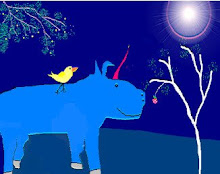
So I looked at my painting of Jesus and a large dog watching an Angel who is standing on a hill that is being climbed by little guys with blue hair. Three small ghost hippopatami are standing behind Jesus, peering around His robe. What does this painting say?

Jesus is all over the place these days. He is even helping the New York Knicks (of St. Lin) and the Denver Brocos (St. Tebow) win games. He is backing all the Republican candidates for President! So why should He not be in my painting directing traffic? The ghost hippopatami are tagging along from the Big Game Preserve in the Sky that shelters all the extinct and endangered species that have left this world. The giant dog is there because, due to translation error, the line "Father, Son and Holy Canine" never made it into the Bible. Dogs are Love and Love is Spirit, Amen, Amen. Jesus, the ghost hippopatami, and the Holy Canine are watching the Angel in case she needs help (angels are so very busy these days) and the little blue-haired guys are senior citizens attempting to migrate to Canada before they turn 70, after which point the Canadian government will reject them. Since Jesus is backing candidates who want to do away with Social Security, watching over them is the least He can do.

That is what I am saying.

Sunday, February 12, 2012

IN LOVING MEMORY OF DR. GERTRUDE NEILSON

It is impossible to live on this planet and be entirely unaware of the freak show that is passing for a presidential campaign in this year 2012. Lately I have been drawn into the insane fulminations and strategies to oppose any health insurance plan that allows women to receive contraceptives. How can people be against abortion AND against contraception? Do they want to go back to the world of my childhood where women had eight kids, three teeth, and worked 18 hours a day seven days a week? What is wrong with these idiots!

I find myself remembering a heroic woman named Gertrude Neilson, a retired medical doctor who, at age 75, ran an illegal womans health care clinic in her home on the edge of the University of Oklahoma campus. In Oklahoma in the 1960s it was a felony to sell or otherwise provide contraceptive devices to any unmarried person below the age of 21. There were a few gas stations around town where the men's room had a machine that sold Trojans at three for a quarter. At that price they were famous for breaking, in flagrante delicto. There were folk remedies involving coke cola and saran wrap. And there was trying to jump out of a 4th story window, as one my dorm mates, who found herself pregnant and disowned by her religious fanatic parents, tried to do.

But that wasn't all we had. We had Dr. Gertrude Neilson, whose name and phone number were written on the walls of every lady's room on campus and for a several-mile radius beyond. She provided contraceptives, sex education, and well women's care to any young woman who had the courage to knock on her door.

It did take courage. We were for the most part virtuous young ladies brought up in the 1950s, crossing our ankles and waiting for Mr. Right, as God and our parents expected of us. In going to Dr. Neilson's unmarked door we were defying our parents, God, and the State of Oklahoma.

I remember my journey to Dr. Neilson's door. I had fallen in love with beautiful Brenn of the wavy black hair and big brown eyes, who read poetry out loud. Our attempts to stop the train just short of the Promised Land were becoming increasingly feeble and half-hearted. We planned to spend the rest of our lives together, so how wrong could it be? I called Dr. Neilson and in a tiny, quaking voice requested an appointment. She had a pronounced Norwegian accent and a rich, warm voice. "You come in and see me. It's okay. I see you soon!"

She lived in a big, two-story brick house surrounded by beds of flowers. I walked up the path to her door and across the big wooden porch like a person on her way to be hung. I rang the door bell and stood there, quaking and wondering if I was going to pass out. I was a sinner, and, with this act of premeditation, a first degree sinner.

The door opened and big, wonderful old woman who looked like the star of every oatmeal commercial you've ever seen reached out one big calico-covered arm and pulled me in, chuckling and making warm, little clucking noises. She interviewed me, went over me from head to toe, gave me wise counsel about love, sex and life, and then gave me birth control pills, saying, "Now, these take one month to start working so you stay on the wagon for one month!" shaking her finger vigorously. "Then you come back and see me again, so I see you are okay!"

I floated out of her office on a pink cloud of love and anticipation. On behalf of all the many hundreds of young women you saved from forced marriages, lives postponed, back alley abortions, suicide, Dr. Neilson, I thank you.

Friday, January 27, 2012

16 PICTURES OF ANGELINA GRIMKE - WHAT ARE THEY WORTH?

Kathy Freeperson - poet, performance artist, radical feminist, activist, all around troublemaker - was my dear friend and writing partner for ten years. In 1992 we wrote and directed an evening of performance art, called BODY, MIND AND SPIRIT, that was so kick-ass wonderful women drove 200 miles to see it, and we filled the theater every night for a three-weekend run. We were then invited to perform it on the main stage at Florida State University in Tallahassee. At the end of the show, the audience rushed the stage. Poets don't often get to feel like rockstars - that was our night!

Shortly thereafter we were invited by the Women's Studies Department at FSU to give a Saturday afternoon poetry workshop, for which we would be paid $75 apiece. When it came to poetry, Kathy and I were easy lays - we would go almost anywhere for $75.

Kathy had many wonderful qualities, but when it came to money she was cheaper than Holloween candy on the Fourth of July. No one ever came out on top in a financial transaction with Freep (as she was called). So when I learned that our money would come in the form of a $150 check made out and mailed to Kathy, I could see that even on my economic scale, this was not going to be a profitable venture.

We worked out the finances of going up to Tallahasse. We would split the gas and motel bill evenly. Since I don't drive Kathy would have to do all the driving. In return I would pick up the restaurant tabs. Kathy ate often and she ate hearty, so this was going to be no small outlay.

We were accompanied by Kathy's 18-year-old toy poodle, Angelina Grimke, who was blind, arthritic, and farted incessantly. Kathy insisted that Angelina ride on my lap the whole trip there and back - to keep her safe and because, as she explained to Angelina who kept attempting to hobble into the back seat, "Your Aunt Arupa loves you SO MUCH."

It takes the state of Florida a long time to get around to paying people, so Kathy got our $150 check about three months later. She came over and gave me $20, explaining that "I had to pays some bills, and I'll get the rest to you later." Two months later she dropped by and gave another 20 dollars. I said that getting the money this way was taking some of the ya yas out of getting 'magic poetry money', as we called it. Kathy sniffed and said, "Unlike me, you are a married woman receiving the benefits of white male privilege so you should have no complaints." Okay.

A few months after that Kathy came by and gave me a Kodak envelope. She said it contained copies of all the pictures she had taken on the trip and should be more than equivalent to the 35 dollars she owed me. Whatever. I took the pictures. Later on I opened the envelope to find two pictures of me, two pictures of Kathy, and sixteen pictures of Angelina Grimke. I muttered, "**** you Freep!" and stuffed them into the back of a desk drawer.

In 2002 Kathy died of complications from diabetes. I was with her when she died. I knew from one of her poems what song her mother always sang to her when she was
falling asleep, so I held her hand and sang, "You are My Sunshine" as she drifted peacefully out of this world.

Several years later, when the whole episode of our trip to Tallahasse was long forgotten, I was cleaning out my old desk and found the 16 pictures of Angelina Grimke. The years fell away and I was remembering my beloved Freep and all the times we had - nothing could have brought it all back more than these pictures! I was so glad that she hadn't paid me with pieces of paper I would have taken to the store and traded for toilet paper and cat food. What is that worth? Sixteen pictures of Angelina Grimke turned out to be priceless.

Love you, Kathy.

Monday, January 23, 2012

God of the Magic Hair Brush

I found that day, broke,
my hair so thick and curly
I'd have to cut it off my head,
still in its plastic case,
a new hair brush to replace
the one I lost.

'I won't replace all you lost,
your mother, father, sister,
gone forever,
but here's a new hair brush
just so you'll know I'm here,
as you walk the long, long road.'

'To streets of gold?
really.

'Now I'm old,
I've walked another forty years
on the long, long road.
I need another hair brush,
soon.'

Wednesday, November 2, 2011

THE GREAT FIMO EPIDEMIC OF 1976

Fimo is a form of clay that is used by architects to build models. In art supply stores it is sold in brightly colored squares. Fimo is very pliable and can be baked in home ovens. It is perfect for making miniatures. In 1976, at McGraw-Hill, none of us had heard of Fimo until one day Helen walked into the employees lounge wearing large fruit basket earrings that were the most remarkable items most of us had ever seen hanging from a human ear, except in illustrations in National Geographic. They were perfectly made and shiny. With these earrings you could get a job in the chorus line of South Pacific. Helen announced that she had made these earrings herself. That was pretty hard to believe. Helen spent her spare time going through catalogues and ordering Stale Cracker Refreshers and soap dishes that play Edeilweiss. If she could do this!

That weekend found most of us at the art supply store buying Fimo. Fimo turned into an obsession. It even reached the point that an informal support group of Fimo widowers formed - men who had been living on TV dinners and spending lonely evenings watching TV with Mr. Hand, for months and months. I would overhear them in the lounge,

"She comes home from work and walks straight to the Fimo table."

"I woke up at 4 a.m. and she was at the Fimo table."

I began to moonlight for a dollhouse store, I made little plates of bacon and eggs or hamburger and fries and fruit bowls, mainly. Then I got an order to make 45 dogs, each one a recognizable breed. I had minus zero qualifications for this task. I sweated like a pregnant wart hog trying to make a banana that actually looked like a banana. So of course I said, "Yes,no problem, when do you want them?"

I had a month. I checked dog books out of the library and spent every waking moment I wasn't at work - unto the wee small hours of the morning - on this project. Dalmations. Russian Wolf Hounds, Jack Russell Terriors... Every moment I had to be outside I studied each passing dog. Months after the dog order was completed, I'd see a dog and my first thought would be, "He's scratching his ear at a 45 degree angle."

A week or two into this dog project I began to feel poorly. I was living on crackers and getting 4 hours of sleep a night. So I devised a special diet that could be prepared in advance and that would include an item from each category in the Food Pyramid.

FIMO DIP: Sour cream (dairy), bacon bits (meat), canned peas (green vegetable), dried onion soup mix (salad?)served with potato chips (starch), and peanut M&Ms (nut).

I actually finished this order, to the satisfaction of the shop owner and got my five cents an hour. It was, for me, what alcoholics call, "Hitting bottom." My Fimo obsession tapered off, as it did for my fellow addicts. To this day I have a few squares of Fimo in my scrap box, and once in a blue moon I make a hot dog or an apple.

Sunday, October 30, 2011

MY EXPERIENCES WITH BANKING AND THE CAPITALIST SYSTEM: A PERSONAL MEMOIR

The Occupy Wall Street Movement and the plight of those who are watching their 401Ks (whatever they are) disppear into the maw of the one percent, have brought to mind my own memories of participation in capitalist America. They began early.

My mother gave birth to me nine months and one day after her 18th birthday. My father, whatever his sins may have been, did not engage in conception with an underage female. My mother was not prepared to be a parent. My parents had me call them Edith and Bill, and that is what they were, an Edith and a Bill. Edith struggled with parenthood, with a spectacular lack of success (that is another story) until Bill dumped us. I was three at the time. She left me in Vermont where I ended up living with my grandmother. My grandmother was less than thrilled. Nevertheless, she took up this role of caretaker with a grim and Vermontish determination to do it right.

For my sixth birthday I received several greeting cards, from friends of the family, that each contained a dollar bill. Visions of ice cream cones and barrettes danced in my head, until my grandmother announced that it was time for me to learn thrift and the value of money. She took me to the local bank and opened a savings account for me, with these dollar bills. She was the co-signer on the account, due to my extreme youth. I stood in the cavernous, Dickensian lobby of the bank and watched my birthday money disppear, to be replaced by a small ledger book, with my deposit recorded by hand. The bank manager came out from behind the massive mahogany counter and shook my hand. He welcomed me to the family of depositors at the First National Bank of North Bennington, Vermont and gave me a short lecture on the importance of saving money for one's future.

On a happier note, she also opened a Christmas Club for me, which I was to pay into at the rate of fifty cents a month, money that I could earn by doing extra chores. The following November I would receive $12 to spend on buying Christmas presents. I thought this was cool. The happiest day of the year at our house was the day we went to the nearby metropolis of Bennington and did our Christmas shopping, at Woolworths, which had a vast array - a Sultan's treasury - of fabulous gifts that could be purchased for five and ten cents apiece. Twelve dollars was a fortune and I was able to amaze my friends and relatives with little glass animals, a ceramic rooster, hair bands, and once some very cute little glasses with people dancing on them, that I bought for my grandmother. They were shot glasses. My teetolling grandmother had years and years of fun telling the story of how she received a set of shot glasses from me when I was in the third grade. Christmas shopping day was also the one day of the year that we ate at a restaurant, always the same one - The Green Mountain Diner - where we would have a hot turkey sandwich and a piece of apple pie. This was our yearly glimpse into lifestyles of the rich and famous, and we both savored every moment of it.

As the years rolled by, she continued to deposit my Christmas and birthday money into the savings account, and to show me the little book that slowly grew until, when I was a senior in high school, I had almost three-hundred dollars. It was in April of my senior year that my personal 1K (as opposed to 401K) bit the dust. I came home from school and walked in to find my grandmother smiling from ear to ear as she gazed down on a long-held dream come true - a brand new vacuum cleaner. She had closed out my account and bought a vacuum cleaner and a few other incidentals. She was ecstatic!

My reaction at the time was a kind of weary, "whatever." The money had never seemed like mine anyhow. In retrospect, I am able to be even more forgiving. My grandmother had known very little in her life but hard work and deprivation. She grew up working on her father's farm. When she was 16 her father sold her to a French Canadian logger who walked down to Vermont looking for a wife. When she was 17 she had her first baby. Her husband turned out to be a hopeless alcoholic and she spent the rest of her life working and raising children. She really wanted that vaccuum cleaner and by God she saw a chance to get it and got it she did! Good for you, Gramma, wherever you are. You were right - I was young and I had a better shot at life than you ever did. I didn't need the three hundred dollars.

The day after I graduated from high school she put me on a plane bound for Oklahoma City, where Edith had been living all those years. She had re-married and produced two more children. I was to spend the summer with her and then start life at the University of Oklahoma. Despite the demise of my savings account, I had money with me, $400 I had earned writing the best essay on "Why I Want to Be a Vermont Tree Farmer." This essay contest was sponsored by the Vermont Tree Farmers Association and was open to all Vermont high school seniors. I had no desire whatsover to become a tree farmer but I did know that I had a talent for writing and to heck with the poor sods that actually wanted to become tree farmers.

I graduated from high school on a Saturday night, boarded the plane on Sunday morning, and arrived in Oklahoma City Sunday night. Edith, who was the manager of Manpower Inc., a temp agency, gave me the glad tidings that I had a job, beginning at 8 a.m. the following morning, as a file clerk at the Oklahoma Department of Motor Vehicles. I had a pretty good case of whiplash that might be called Solomon Grundy Syndrome. Remember him?

Solomon Grundy,
Born on a Monday,
Christened on Tuesday,
Married on Wednesday,
Took ill on Thursday,
Grew worse on Friday,
Died on Saturday,
Buried on Sunday.
This is the end
Of Solomon Grundy.

When Edith helped me unpack she discovered the money order for $400 and suggested that I let her deposit it into her account, where it would be safe until I left for college in the fall. Here we go again....(my private thoughts), but I was a compliant child and I signed the money order over to her. The Department of Motor Vehicles paid me $35 a week. Edith gave me an allowance for busfare and nylons and that sort of thing and put the rest of my princely income into her account.

In the fall - surprise! - she told me that she had borrowed my money to cope with unforeseen expenses. I asked when she was going to pay me back and she snapped, "I've provided you with free room and board all summer and you have the nerve to ask me when I'm going to pay you back?" I concluded that the answer was "never," and indeed it was. When she and her husband dropped me off at the dorm her husband slipped me ten dollars and I began life on my own in capitalist America.

I did have a job, however. I was enrolled in the University's Work Study Program. There was one hitch. The University had a Student Minimum Wage of 60 cents an hour. The program was actually a form of indentured servitude whereby students bussed tables, scrubbed pots and pans, reshelved library books, cleaned the football stadium, raked leaves, pulled weeds - etc. etc. - for sixty cents an hour. Banking was not a problem. Even in the fall of 1963 sixty cents an hour disappeared so fast, I even had to shop lift an occasional tube of toothpaste, just to get by.

When I got real jobs, later in life, and had a little real money, I still never put much away into banks. The way I saw it, you could spend your life working at the Widget Factory and saving for your old age, or you could spend your money going places and having experiences and doing whatever it was you really wanted to do. So I opted for that. Let the ants have a safe old age. I would be a grasshopper (or as James Joyce so wonderfully said, "A Gracehoper.")

That was my heritage from Edith and my grandmother - don't spend your life working and banking - you may lose it all anyhow. Follow your dreams. Thank you, oh my distant progenitors, for this wonderful lesson. Even if I wind up spending my old age living under a bridge, I will be grateful for the wonderful life I've had.